
Applications with no answer: the costliest hiring habit in Southeast Asia
More than half of job seekers in Indonesia have applied and heard nothing back. A clear answer at every stage costs little to give, and keeps the best candidates interested.
Dimas sends his application from his phone on a Monday morning. A week passes, then a month, with no word at all. He does not know whether it was read, rejected or lost. Dimas is invented, but his experience is common: silent hiring is the costliest hiring habit in Southeast Asia, and the easiest to fix.
More than half of job seekers in Indonesia have had no response
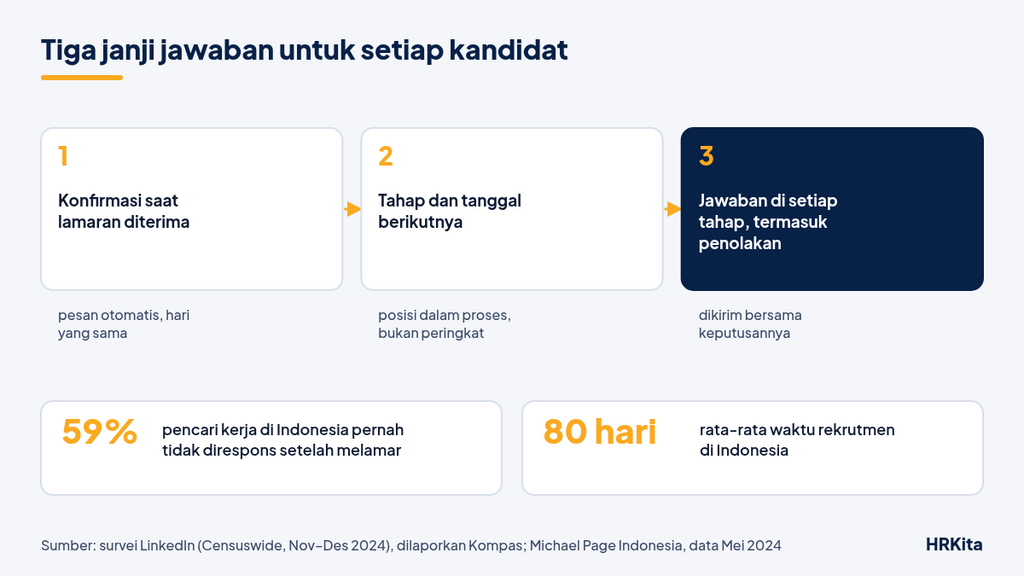
In a LinkedIn survey run by Censuswide in November and December 2024, as reported by Kompas, about 59 percent of job seekers in Indonesia said they had received no response at all after applying. In the same survey, 80 percent of recruiters said they were receiving more applications than before.
The volume is real. The 2024 civil-service (CPNS) selection, according to BKN, recorded almost 4 million registrants for about 250 thousand positions. In the private sector, SmartRecruiters' 2025 global recruiting data counts an average of 73 applicants per role. At that volume, a small HR team often goes silent because it cannot reply to everyone.
Silence is not neutral: the best candidates leave too
A candidate who hears nothing assumes they were rejected, and often really does leave. A 2023 survey by SEEK and Boston Consulting Group of 97,324 respondents across six Asian markets, Indonesia included, found that 49 percent would turn down an attractive job offer after a poor hiring experience.
The wait is long, too. According to Michael Page Indonesia data as of May 2024, the average time to hire in Indonesia is 80 days. With no news for that long, the most sought-after candidates have usually accepted another offer before you call.
Three simple promises that change the candidate experience
A clear answer does not need a large team. It needs promises written down first, then kept by a system and by the people responsible.
- An acknowledgement when the application arrives. One automatic message naming the vacancy and when the candidate will hear next.
- The next stage and its date. Candidates know where they stand in the process, not their rank against other applicants.
- An answer at every stage. Every candidate deserves an answer, including a rejection. A polite, prompt rejection respects a candidate more than silence does.
How to do it without adding people
Write a message template for every stage before the vacancy opens: received, moving to the test, moving to interview, not moving forward. Decide who sends each one and within how many working days. Send the answer together with the decision, not after the vacancy closes. This habit removes the "later" queue that keeps candidates waiting for months.
In HRKita™
At HireKita, DataKita's recruitment service, we are preparing an applicant portal with our founding clients: candidates apply from a phone, then receive a private status link that shows their stage, their next step and its date. Our recruitment service is already running and is delivered by DataKita's consultants.
Once a candidate joins, their ID card and work-document requests are handled at HRKita Employee Services, with no login needed. Talk to our team about keeping your candidates informed.