America dropped degree requirements, but hiring barely changed
Large US employers removed degree requirements from their job ads, yet real change reached not even 1 in 700 hires. The lesson: replace the diploma requirement with evidence of ability.

Since 2014, thousands of roles at large US employers have dropped the bachelor's degree requirement. The message sounds right: ability counts, not the diploma. A 2024 study by the Burning Glass Institute and Harvard Business School checked whether hiring actually changed, and the answer is sobering.
The requirement left the ad, but not the recruiter's mind
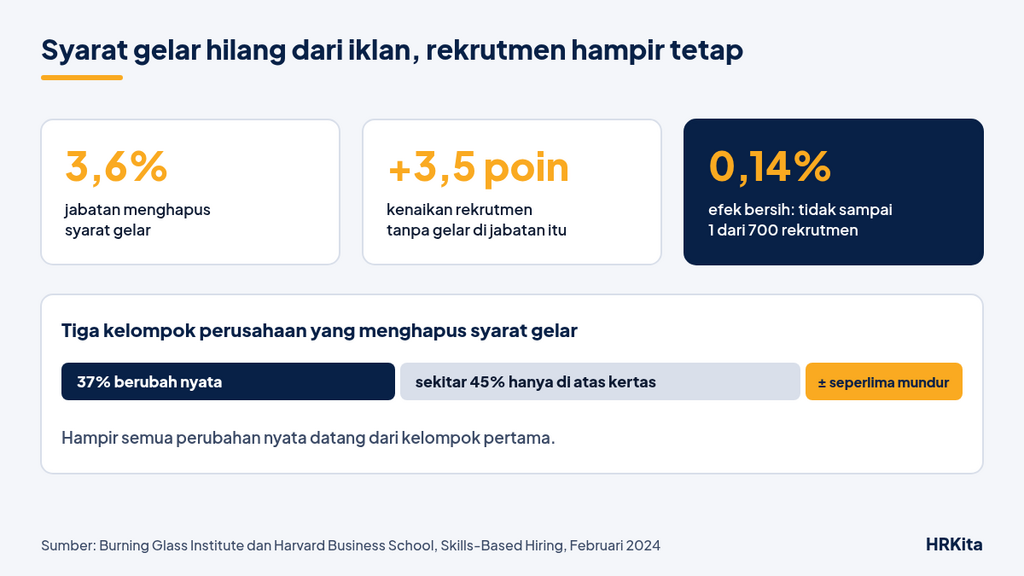
The study traced 11,300 roles at large firms from 2014 to 2023. The number of roles dropping degree requirements each year grew almost fourfold. In those roles, the share of hires without a bachelor's degree rose by about 3.5 percentage points.
The catch is that the rise applied only to the 3.6 percent of roles that dropped the requirement. The net effect was only 0.14 percent: about 97,000 workers a year out of 77 million hires. Put differently, the new opportunity promised by skills-based hiring reached not even 1 in 700 hires that year.
Only about a third of firms really changed
The same study sorts firms into three groups. About 37 percent of the firms that removed degree requirements produced nearly all of the real change. About 45 percent changed in name only, and about one in five ended up hiring fewer people without degrees.
Removing a requirement from the ad does not change how people choose. As long as interviews still ask about the university and assessors still use the diploma as a shortcut, candidates without degrees are filtered out at the next step.
Firms that made the change were rewarded. Employees without degrees hired into roles that used to require one stayed longer, with a retention rate 10 percentage points higher than their degree-holding colleagues, and their pay rose by 25 percent on average.
New York requires bias audits for automated hiring tools
On the technology side, New York City's Local Law 144 took effect on 1 January 2023, with enforcement from 5 July 2023. An employer using an automated employment decision tool must have it bias-audited by an independent auditor no more than one year before use, publish the audit summary on its website, and notify candidates at least ten business days in advance.
A rule alone is not enough. An audit by the New York State Comptroller in December 2025, based on a copy of the report, found only 2 complaints received in two years. Across 32 companies reviewed, the auditors found at least 17 instances of potential non-compliance, while the enforcing agency had found 1.
Lessons for HR in Indonesia
Many vacancies in Indonesia still require a specific diploma for work that could be tested directly. The US experience shows that changing the words in the ad is not enough.
- Start from the job's activities. Write down what the person in the role does every week, then define the evidence of ability it needs.
- Test ability; do not only read diplomas. Replace "which diploma do you hold?" with "what can you do?". A short work test, the same for every candidate, makes assessments comparable.
- Measure the result in hires, not in ads. Count how many candidates without degrees are actually hired, not how many ads changed their requirements.
In HRKita™
The HRKita consulting team builds job architecture and competency models from the real activities of each role. For hiring, HireKita writes the job brief from the role's activities and uses a technical test per role; some features are available now and the rest we are preparing with our founding clients.
Once employees join, tiered contract evaluation and the annual appraisal run in HRKita Performance and Evaluation, so evidence of ability keeps being recorded. Talk to our team about hiring on ability.