
Digital PAF: one recorded track for transfers, promotions and pay changes
A Personnel Action Form (PAF) puts the request, the tiered approval and the change to employee data on one track, so every pay change has a requester, an approver and a date.

In a depot network, a branch head asks for one of their salespeople to be promoted to supervisor on a new salary. The request goes by text message to head-office HR, HR drafts a memo, a director initials it, payroll changes the scheme, and three months later nobody can find out who approved the salary figure. A digital Personnel Action Form (PAF) turns that chain into a single, recorded track.
A digital PAF is one form for every change to an employee's core data
A PAF covers every personnel action that changes an employee's core data: a transfer between depots or brands, a change of position, a promotion or demotion, an adjustment of basic pay or allowances, and a change of contract status. The requester raises the form, HR checks it, and approvers sign it off according to the defined tiers. On approval, the system applies the data change; payroll does not re-type it.
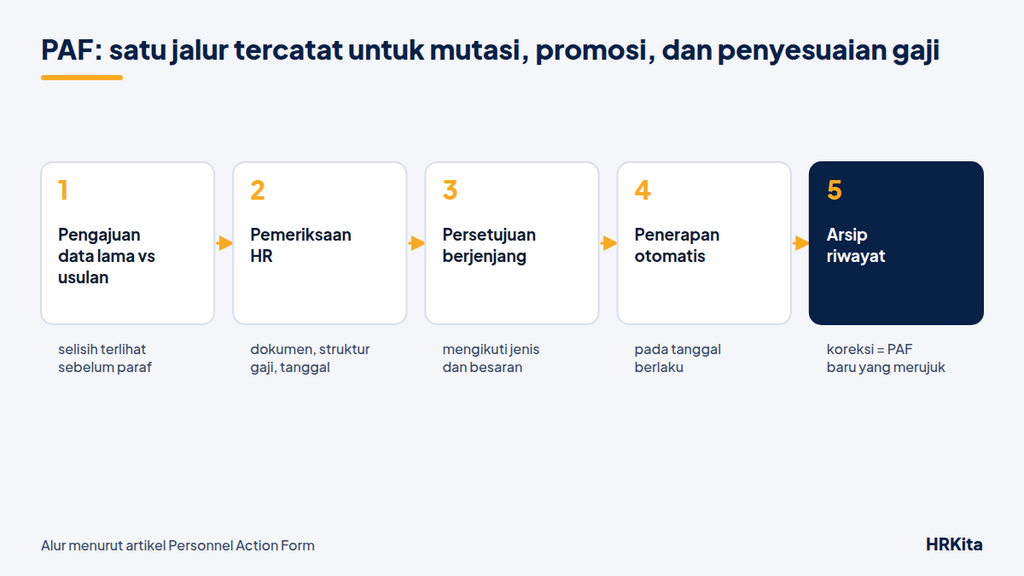
Five stages take a change from request to archive
- Request. The requester selects the employee and the type of action. The form shows the current data on the left and the proposed data on the right, so the difference is visible before anyone signs.
- HR check. HR checks that the documents are complete, that the change fits the pay structure, and the effective date.
- Tiered approval. The tiers follow the type of action and its size: a promotion with an increase above a set threshold goes up to a director, while a transfer between depots needs only the regional head. Every stage records who, when, and what note was left.
- Application. On the effective date, the employee's data and pay scheme change automatically. The next payroll period reads the new data.
- Archive. A completed PAF becomes part of the employee file. The history of positions and pay is built from PAFs, not from memory.
Every role stops chasing and starts checking
| Role | Before | With PAF |
|---|---|---|
| Depot head | Text message, no idea of the status | Submits, sees which stage it is at |
| Head-office HR | Drafts memos, chases initials | Checks one queue |
| Director | Initials a stack of paper | Approves only what is above the threshold |
| Payroll | Re-types the changes | Does not type; verifies |
The PAF history settles pay disputes years later
A pay dispute two years on, a labour inspector's audit, or the owner asking "since when has he been paid this much" is answered by the PAF history. Every change has a requester, an approver, a date and a reason. That history cannot be edited; HR corrects it with a new PAF that refers to the old one.
Example: a transfer from the Bekasi depot to the Karawang depot
A salesperson from the Bekasi depot moves to the Karawang depot from the 1st of next month. The PAF holds the old and new depot, the old and new pay scheme (the Karawang UMK, the district minimum wage, is different), the new line manager and the effective date. This month's payroll still reads Bekasi; next month it reads Karawang automatically. The Karawang depot head validates next month's attendance because the person is already on their list. There is no email and no re-typing, and six months later the history answers the question of why the pay changed.
A PAF records decisions; it does not make them
A PAF manages changes that have already been decided. The pay structure that determines whether a promotion figure sits inside the grade range is separate work, and the PAF only flags a figure that falls outside the range. Onboarding a new hire is not a PAF either; joining has its own form.
In HRKita, the pay-change trail already runs; the full PAF form is discussed per client
In HRKita, part of this track already runs: pay schemes with tiered approval and bulk adjustment per depot, salary revision through a versioned workbook, and an audit trail that records who changed what, when, the old value and the new value. The full PAF form, one form for transfers, promotions and contract-status changes applied automatically on the effective date, is not something we present as a general feature. How it would run for your depot network is agreed per client; ask about it in a demo.